What happens when you reread?
The words are familiar. You read faster, the sentences make sense on contact, and you recognize points as they arrive. That smoothness is real, but it is recognition, not recall. Recognition is easy; recall, producing the idea without the page in front of you, is what you need when you want to use or talk about a book later.
What did the studies find?
In Roediger and Karpicke's experiment, students read prose passages and then either restudied them or took recall tests without feedback. Five minutes later, restudying looked better. After two days and after a week, the students who had tested themselves recalled substantially more, even though restudying had made students more confident in their ability to remember.1
Callender and McDaniel ran four experiments with textbook chapters and a magazine article, comparing one reading with two. With only a few exceptions, the second reading did not significantly improve performance on multiple-choice, short-answer or summary tests, and reading ability did not change that pattern.2
A large review of study techniques rated rereading as low utility for the same reasons.3
Is rereading ever worthwhile?
Yes, for different reasons. Rereading a favorite novel for pleasure, or to see how an ending was set up, is its own reward. Rereading a passage you did not understand is necessary. And after a long break, rereading the last few pages before your place helps you get back into a story. The point is narrower: as a way to remember, rereading on its own does less than it feels like.
What should you do instead?
- Recall first. Close the book and try to bring back what you read.
- Check. Look back and find what you missed or got wrong.
- Reread only that. Targeted rereading after a recall attempt is far more efficient.
The retrieval question list gives you prompts for the first step.
Why confidence misleads
Psychologists call the feeling of knowing a judgement, and judgements are built from cues. One strong cue is fluency: how easily the text flows when you read it. Rereading raises fluency, so it raises confidence. But fluency while the page is open says little about whether you can produce the idea when the page is closed. That is why the students in Roediger and Karpicke's study who restudied felt more confident and remembered less.1
A recall-first reread routine
- Before rereading a chapter, write down everything you remember about it in two minutes.
- Skim the chapter and mark what you missed or got wrong.
- Reread only those parts, slowly.
- Close the book and recall the chapter again, briefly.
The reread becomes a check on your recall rather than a substitute for it, and you spend your time on the parts you actually lost.
Is this true for novels too?
The studies above used prose passages, textbook chapters and a magazine article, tested for recall and understanding. Nobody has shown that rereading a favorite novel is a waste, and rereading for pleasure is not trying to beat a test. The finding applies when your goal is to remember: if you are rereading a chapter because you want to keep it, recall first and the reread will do more.
The one-line version
Recognition is easy and feels like knowledge; recall is harder and builds it. Make the hard step first.
Does reading a recap feel like learning too?
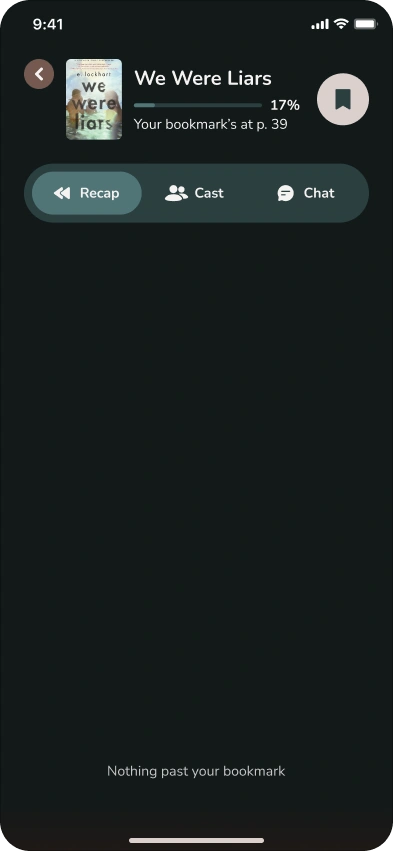
Probably, for the same reason. A recap of a book you have read is familiar and easy to follow, and that ease is easy to mistake for remembering. Rereading has been found to add little to long-term memory compared with other uses of the same time.2 A recap read instead of recalling is likely to behave the same way. Read after you have tried to recall, it becomes a check instead. We look at this in do recaps help you remember a book.
What about rereading a favorite book?
That is a different goal. Rereading for pleasure, or to notice what you missed the first time, is a good reason to reread. The research here is about rereading as a way to remember, where it is weaker than testing yourself.1
How can you tell whether you really know it?
Close the book and explain the chapter, or the story so far, to an imaginary friend. If you can do it without looking, in your own words, you know it. If you stall, the familiar feeling was fluency rather than memory. Note what you could not explain, check it, and try again a few days later.3
Why do people choose rereading anyway?
Rereading and highlighting are among the most common study habits, yet a major review of study techniques rated both as having low utility.3 Part of the reason is that rereading is easy and feels productive, while testing yourself is harder and shows you what you do not know. That feels worse in the moment, even though it works better.
A rule of thumb
If a review feels effortless, it is probably doing little. If it feels effortful but you get there in the end, it is probably working. Aim for the second kind. A little difficulty is the point; complete failure is not, so if you cannot recall anything, check and try again sooner. Notice which parts feel easy and which feel hard, and spend your next review on the hard ones.
When does a second read make sense?
When you did not understand a passage the first time, a reread is the right move: you cannot recall what you never understood. Read it again slowly, then close the book and try to explain it. And for a book you plan to discuss, a quick reread of key scenes the day before can refresh details, as long as you also test yourself on them.